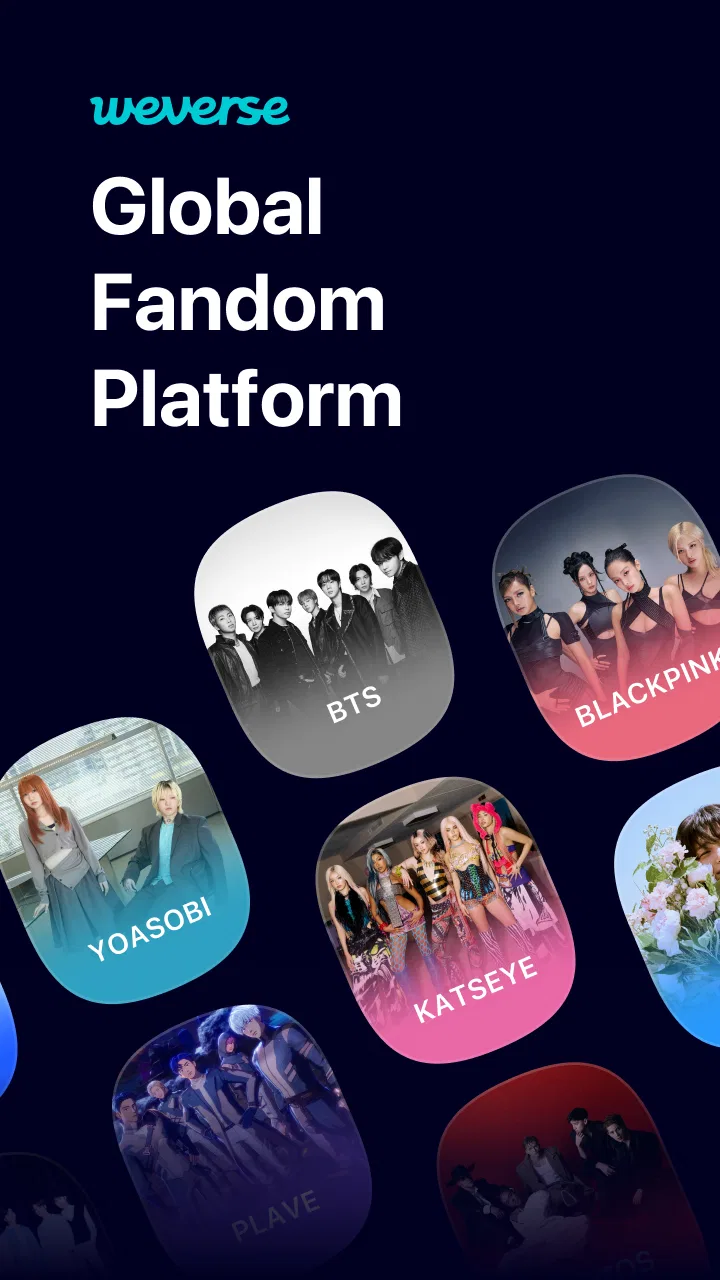
Weverse: Connect with Artists
- 4.6
- Rating
- 10.00M
- Installs
- Free
- Price

 Analysis by App-foxy
Weverse: Connect with Artists is the kind of social app that makes most sense when you already care deeply about a particular artist, group, or fandom. I found it less useful as a general-purpose social network and much more valuable as a focused place to follow official community activity, keep up with artist posts, and feel closer to the fan culture around the people I follow. Its central idea is simple, but the experience becomes more interesting once you use it as a daily fandom hub rather than opening it only when a major announcement appears.
My overall view is positive, with one important qualification: Weverse works best when you want organized, artist-centered fan interaction instead of the noisy mix of unrelated posts found on mainstream social platforms. It is free to install, created by WEVERSE COMPANY Inc., and aimed at a Teen audience. The app has reached more than ten million installs and holds a 4.6 average from roughly 1.1 million ratings, which matches my impression that it has become a regular destination for a large international fan community.
What using Weverse feels like in everyday life
The first thing I noticed is that the app asks me to think in terms of communities rather than individual accounts. I am not simply scrolling through a universal feed and hoping the right post appears. I choose the artist spaces that matter to me, then use those spaces to follow updates, conversations, and fan activity in a more concentrated way.
You May Also Like

 Blood Strike: 2.5 Anniversary
Blood Strike’s Loadouts Turn Every Drop Into a Tactical Gamble
A close look at Blood Strike’s custom loadouts: how fast access to signature weapons reshapes its battle royale rhythm, rewards preparation, and narrows the gap between fights.

 Pandora - Music & Podcasts
Pandora’s Music Is Easy to Start, but Harder to Recover
Pandora’s strength is its low-effort path from a seed to a station. Its weak spot is how much confidence it asks you to place in connection, setup, and quiet recovery.

 8 Ball Pool
 Is Built on Rivalries, Rematches, and Routine
A close look at the rivalries, rematches, shared routines, and unanswered safety questions that turn a quick pool match into a persistent mobile community.

 Samsung Music
’s Quiet Strength Is Playing What You Already Own
Its reach comes less from spectacle than from dependable access to a personal library. That simplicity is both the app’s strongest retention engine and its ceiling.

 AccuWeather: Weather Radar
AccuWeather Review: A Quick, Clear Forecast for Everyday Decisions
For everyday plans, the best forecast is the one you can understand quickly. AccuWeather makes rain timing, radar, and local conditions easy to act on, with a few trade-offs.

 Hill Climb Racing
Why Hill Climb Racing Still Turns Crashes Into One More Run
A tiny car, a bumpy hill and one more upgrade: Hill Climb Racing keeps resurfacing because its simple chaos makes every near-miss feel personal.
More From Our News Desk



That structure changes the rhythm of the app. On a normal social network, an artist update can disappear quickly among news, advertisements, recommendations, and posts from people I barely know. Here, the surrounding context is much more relevant. A post, notice, or conversation sits beside other material connected to the same fandom, so I spend less time filtering out unrelated content.
A realistic everyday use case is checking Weverse during a commute or a short break. I can open the community for an artist I follow, scan recent activity, read a new message, and see how other fans are reacting without jumping between several social services. If I am preparing for a release or event, the app also gives me a single place to revisit the community rather than relying entirely on screenshots, reposts, and algorithmic summaries elsewhere.
I would not describe the experience as a replacement for every social platform. It is not where I would go for broad breaking news, a wide range of independent creators, or casual conversation with people who have no shared fandom interest. Its appeal comes from narrowing the subject matter. That focus is a strength for fans and a limitation for anyone who wants a more varied feed.
A focused home for fandom activity
The strongest part of the app is the feeling of context. When I follow several artists, each community gives me a clearer sense of where a post belongs and why it matters. Instead of treating fandom as a stream of isolated updates, Weverse presents it as an ongoing space with its own conversations and habits.
This is particularly helpful for international fans who may otherwise piece together information from several places. I can use the relevant community as my starting point, then decide whether something deserves a deeper look. That workflow is more practical than trying to monitor every account on a general social network, especially when an artist is active across multiple channels.
Another useful detail is the difference between reading and participating. I can use the app quietly, simply following updates and browsing discussions, or I can become more active by joining the conversation. That makes it suitable for people who enjoy fandom but are not ready to post immediately. I appreciated being able to observe the tone of a community before deciding how much I wanted to contribute.
For a new user, my advice is to begin with only the communities that genuinely interest you. Following everything at once can turn a focused experience into another crowded feed. Starting small makes it easier to understand which notifications matter, which conversations are worth checking, and how often the app deserves a place in your routine.
Why the app feels different from ordinary social media
Compared with a broad platform such as Instagram, TikTok, or X, Weverse feels less dependent on discovering an artist through a general recommendation system. The relationship begins with a fandom choice. That makes the app more intentional: I open it because I want to see what is happening around a particular artist, not because I am waiting for an algorithm to surprise me.
The trade-off is variety. General social platforms are better when I want fast-moving trends, creative edits from many unrelated accounts, or a large public conversation around a topic. Weverse is better when I want the artist-centered setting to remain the main subject. Neither approach is automatically superior; they serve different moods and different kinds of fan behavior.
I also found the concentrated setting useful for reducing the effort of checking several sources. It does not eliminate the need for judgment, since any active community can contain repetitive or distracting discussion, but it gives me a more relevant starting point. That matters when I have only a few minutes and want the important activity from one fandom rather than a complete tour of the internet.
Features that reward a more deliberate workflow
The app becomes more useful when I treat it as a place to organize attention. I do not need to open every notification the moment it arrives. Instead, I can set a simple routine: check artist communities at a convenient time, read official-looking updates first, then browse fan discussion if I have the time. This prevents the app from turning every small interaction into an interruption.
A second practical approach is to separate quick browsing from meaningful participation. If I am only checking for an update, I can stay in the relevant community and leave after reading. If I want to join a discussion, I can slow down and consider the context before posting. That distinction is easy to overlook, but it makes the experience feel less frantic and helps me avoid treating every post as something that demands a reaction.
A third insight is that Weverse is more valuable around moments of heightened interest than during quiet periods. When an artist is active or the fandom is discussing something important, the community gives me a concentrated place to follow the conversation. During slower stretches, the app may feel less essential, particularly if I follow only one artist. I would not judge it solely by a quiet week; its value depends heavily on how active the communities I choose are.
The main weakness: focus can become clutter
My biggest reservation is that a fandom-centered app can still become overwhelming. Concentrating posts around an artist does not automatically make every conversation useful. A busy community may contain repeated reactions, running jokes, speculation, and posts that are meaningful to regular members but unhelpful to someone checking in briefly.
This is where expectations matter. If I want a clean stream containing only the most important official updates, I may find the broader community activity too noisy. If I enjoy seeing the full range of fan conversation, the same activity can feel lively. The app gives me proximity to fandom, but proximity also means encountering the repetitive and emotional parts of online fan culture.
Notifications deserve careful handling for the same reason. I recommend reviewing them early instead of accepting every alert by default. A fan who follows several communities can quickly lose the benefit of a focused app if the phone is constantly asking for attention. Weverse is easier to live with when I decide which updates deserve immediate notice and which can wait until I choose to open the app.
There is also a social pressure that comes with artist-focused communities. A new user may feel that regular participants already understand the customs, references, and preferred ways of speaking. I found that observing for a while is the easiest solution. Reading first helps me understand the community without forcing myself to perform enthusiasm or post before I am comfortable.
Free access and the role of optional spending
The app itself is free, which makes trying it straightforward. I can install it, choose communities, and decide whether the basic experience fits my habits before spending anything. That is important because not every fan needs more than the community and social functions.
There are in-app purchases ranging from $0.49 to $200.00 per item. I see this as a point where users should be intentional. A low-cost optional purchase can feel harmless in the moment, while repeated fandom spending can become substantial over time. I would approach the app with a personal limit and treat purchases as optional extras rather than part of the basic requirement for enjoying the communities.
Parents and younger users should also pay attention to the Teen content rating. Even when an app is built around entertainment and fan interaction, public communities can include strong emotions, arguments, intense enthusiasm, and material that is not ideal for every age. The rating is a useful reminder to consider how the app will be used, especially on a shared family device or by someone who is still learning how to manage online communities.
Who should download it, and who should skip it
I recommend Weverse to fans who want a dedicated place to follow artists and participate in communities built around them. It is especially suitable for someone tired of searching through a general feed for relevant updates, or for an international fan who wants a more concentrated fandom environment. It also suits quieter users who prefer reading first and joining conversations when they feel ready.
The app is a good fit if you enjoy returning to the same artist communities over time. Its value grows when the communities are part of your routine rather than a one-time visit. I can imagine using it before work, during a lunch break, or at the end of the day to catch up on activity without opening several unrelated apps.
I would skip it if I am only mildly interested in an artist and do not expect to check the community regularly. In that situation, a general social platform may be more convenient because it combines many interests in one place. I would also choose another option if my priority is short-form entertainment, broad discovery, or direct messaging with a small group of friends. Weverse is built around fandom participation, not around being the best tool for every kind of social communication.
It may also be the wrong choice for someone who dislikes community feeds altogether. The app’s appeal depends on seeing other fans, reading reactions, and feeling part of an organized audience. If I want a private, minimal stream with no surrounding discussion, the central concept will feel like unnecessary noise rather than a benefit.
What I would do after installing
I would begin by selecting only the artist communities I genuinely follow, then spend a few days learning the layout and the tone of each space. I would avoid turning on every notification immediately. Instead, I would keep alerts limited until I understood how often they appeared and whether they improved my experience.
Next, I would create a simple checking habit. For example, I might look once during a break and once in the evening, rather than reacting to every alert. This makes the app feel like a useful part of my day instead of another source of constant distraction. It also gives me enough time to read conversations properly instead of skimming everything under pressure.
If I decide to post, I would start with a short, relevant contribution and pay attention to how the community responds. The best use of a fandom platform is not necessarily posting the most often. In my experience, it is finding a comfortable level of participation that lets me enjoy the artist connection without making the app feel like an obligation.
I would also keep spending separate from emotional moments. A major announcement or exciting interaction can make optional purchases feel urgent, but waiting before paying gives me a chance to decide whether I really want the item or experience. Since individual purchases can reach a high amount, that pause is a practical safeguard rather than a criticism of the app itself.
Performance expectations and long-term value
Weverse was released on June 10, 2019, and the current version is 3.15.1. It requires Android 10 or later, so owners of older Android devices should check compatibility before planning to use it as their main fandom app. For supported phones, the more important question is not whether the app is novel, but whether the communities I care about remain active enough to justify regular visits.
The large audience is encouraging because a social app needs active participation to feel worthwhile. At the same time, popularity alone does not guarantee that every artist community will feel equally busy or useful. My experience would depend on the artists I follow, how often they communicate, and whether other fans use the community in a way that matches my interests.
That is why I see the app as a companion rather than a universal social replacement. It can become the main place I check for a particular fandom while still leaving room for other platforms when I want video discovery, general news, or broader conversation. Trying to force it into every social role would make its limitations more obvious.
My final recommendation
Weverse: Connect with Artists succeeds because it gives fandom a dedicated home instead of treating artist updates as just another category in a giant public feed. I like the concentration, the sense of community, and the ability to build a daily routine around the artists I actually care about. The experience feels most rewarding when I use it intentionally: follow a manageable number of communities, control notifications, and participate at my own pace.
Its weaknesses are real. Community activity can become repetitive, notifications need supervision, and optional purchases require self-control. It is also not the right tool for people seeking broad social discovery or a private messaging-first experience. Still, those limitations come from the same focused design that makes the app appealing in the first place.
My verdict is that Weverse is worth trying if an artist or group already occupies a meaningful place in your life. The free entry makes experimentation easy, while the Teen rating and optional purchase range are good reasons to use it thoughtfully. For dedicated fans, it can turn scattered updates into a more coherent daily connection. For casual observers, it may feel too specialized. I would recommend it to the first group, with the clear advice to shape the app around my own attention rather than letting the fandom feed shape the entire day.
FAQs for Weverse: Connect with Artists
01What is Weverse and how does it work?
Weverse is a fan community platform that allows users to connect with their favorite artists. Users can join various artist communities, access exclusive content, participate in fan events, and interact with other fans. The app serves as a hub for official updates, merchandise releases, and artist-hosted live streams, making it a must-have for devoted fans.
02Is Weverse free to use, and are there any in-app purchases?
Weverse is free to download and use, offering access to general content and community interactions. However, it does feature in-app purchases, such as exclusive content, merchandise, and membership subscriptions that provide additional perks. These purchases enhance the user experience but are not required for basic app functionality.
03How can I interact with artists on Weverse?
Weverse offers various ways for fans to interact with artists. Users can comment on posts, participate in live chats during artist-hosted events, and sometimes receive direct responses from the artists themselves. While direct interaction isn't always guaranteed, the platform facilitates a closer connection between fans and their idols.
04What kind of content is available on Weverse?
Weverse provides a wide array of content including exclusive photos, videos, music releases, and artist-written posts. Additionally, fans can access behind-the-scenes content and participate in community events. Content availability may vary based on the artist's engagement and the specific community you join.
05Is Weverse available for both Android and iOS devices?
Yes, Weverse is available for download on both Android and iOS platforms. Users can find the app on the Google Play Store and Apple App Store, ensuring compatibility with a wide range of devices. Regular updates help maintain app performance and introduce new features for all users.
Pros
- Exclusive artist content and updates.
- User-friendly interface with smooth navigation.
- Engaging community for fan interactions.
- Personalized notifications for favorite artists.
- High-quality livestreams and videos.
Cons
- Limited offline content access.
- Some features require in-app purchases.
- Occasional app performance lags.
- Language options are somewhat limited.
- Event notifications can be overwhelming.

Weverse: Connect with Artists
Gallery